
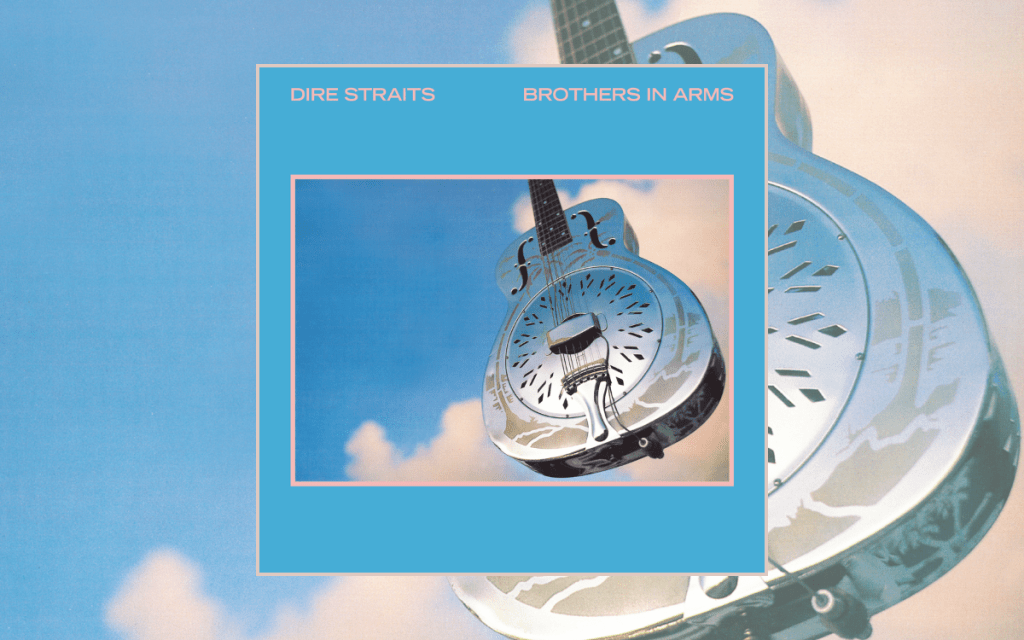
Yesterday (as of this writing) was the 41st birthday of one of the world’s best-selling albums, having sold more than 30 million copies worldwide. 41 years ago, Dire Straits released a seminal album that would not only become one of the most iconic of the 80’s but one that would become significant to music history at large. In this editorial, I’m going to explore and celebrate Brothers In Arms, a record that’s not just been important to music but one that’s been important to me at different times in my life.
The Art
Immediately with this album, you’re greeted by the striking cover art. While we’re often encouraged not to proverbially judge a book by its cover, it is part of the business when you’re trying to engage people in your art, whether it’s books (seriously, publishers, stop doing the same homogenized book covers that every book has these days—they’re terrible), movies, or music. You’d be forgiven for judging this album by its cover, because it’s rather fitting, even if it maybe can’t capture the more diverse offerings on the second half of the album. It’s a surreal and dreamy album cover, paired with a mellow and soft color palette. The guitar seemingly ascending to or descending from the heavens on the front of the album cover is Mark Knopfler’s 1937 14-fret National Style “O” Resonator, which is beautiful in and of itself. That image was photographed by Deborah Feingold, who was not assigned to shoot for the album cover at all, just publicity photos of the band. The low-angle shot was completely off-the-cuff, a quick photo at sunset, according to Deborah. Little did she know it would be featured in one of the most eye-catching (and marketable) album covers of the 80’s. I have no doubt that the aesthetically pleasing cover art had at least a little bit to do with the overwhelming sales; there’s an inviting “immediacy of accessibility” if you will. Couple that with the music and you’ve got a hit on your hands.
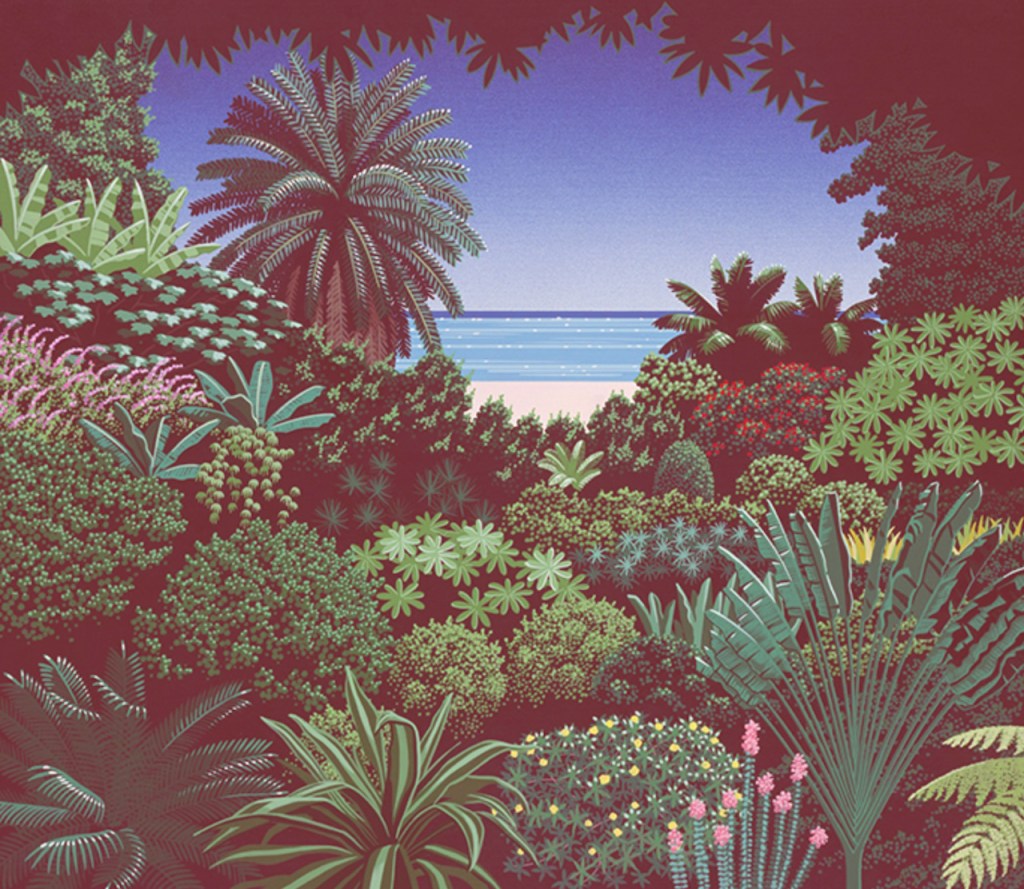
The back cover is a story all its own, one that involves an artist named Thomas Steyer. Thomas was at something of a creative crossroads in his career and was trying to build a repertoire of clients; he would reach out to companies and people, borrow items, and then proceed to paint them an oil-on-canvas that they could purchase. His strategy proved to have legs, leading to paintings for Jaguar and Shure. In that vein, Thomas had also reached out to some of his favorite musicians, looking to paint guitars. In his own words, Thomas caught Mark Knopfler at a good time and picked up a guitar from him personally (the same one featured on the front of the album). The two discussed colors, and Mark mentioned his fondness for ocean blues and turquoise, so Thomas envisioned a seascape and painted an abstract scene with a lagoon, a wave, a pink beach, hills, and snow-capped mountains. In the foreground, the palm trees that are built into the guitar itself. The result was a seven foot painting of the guitar, featuring the aforementioned surrealist seascape. All parties were delighted with the result, Mark bought it, and the management of Dire Straits offered to use the painting on the back of Brothers In Arms. Serendipitously, there was just enough time to include it on the back cover, which otherwise would have been left plain. The painting wouldn’t just be relegated to the back cover, two different shots of it would go on to be featured on the artwork of two singles, ‘So Far Away‘ and ‘Why Worry‘, respectively. I’m a big fan of this painting, particularly its close-up use on the ‘So Far Away’ single.
The Songs
The album opens with a song that is quintessential 80’s. One may think “Money For Nothing” should easily usurp “So Far Away” as a bonafide distillation of the decade, but “So Far Away” is just shy of being Synthpop. The predominant instrument of the song is a synthesizer, the Synclavier, under-pinned by Mark Knopfler’s more standard guitar fare. Underneath that, a soft and swelling synth pad. Then you have the vocal harmonies and tambourine (which to my ear veers closer to sleigh bells, but the credits suggest otherwise). It is by far the most “80’s Pop” that Dire Straits ever got. It’s sonic pastel, matching the color palette of the album art and the painting it sports on its single. Lyrically, on the surface, the song is a sentimental protest against long-distance relationships. That said, the lyrics can be applied to any kind of distance between two people. This tune is often used to emotive effect in movies and television, I recently heard it in Margo’s Got Money Troubles, and my personal favorite use comes from season four of Halt And Catch Fire; it’s used following the death of a main character, while the rest of the main characters pack up his house. A big favorite of mine in the Dire Straits catalogue and a song I’ve listened to hundreds, if not thousands, of times in my life.
Next comes “Money For Nothing”, which was ironically MTV bait. Despite being a take-down on pop culture and videos of the time, MTV ate it up, and ran the video regularly. It’s easy to see why. From the moment the song opens, it features Sting’s trademark background vocals singing MTV’s classic slogan (I want my MTV), a now iconic drum fill, and an ultra-slick electric guitar riff. The video itself was high-tech for the time too, featuring early 3D animation that illustrated the lyrics. While the lyrics may feature language that some would find offensive, most people also fail to understand that the song is entirely satirical, using the narrow (low-rent, bigoted, mean-spirited) perspective of a fictional blue-collar character (literally depicted in the video, mocking Mark Knopfler himself) and effectively taking the piss; a quality of a few Dire Straits songs (see the later recorded “Millionaire Blues”). Personally, my view is this: the second we start questioning (and censoring) artistic license because we don’t like a word or the perspective something is written from, that’s the second art loses authenticity. I won’t harp on that any further. An interesting tidbit before moving on, MTV actually used a sample of Sting singing on this song for their MTV Entertainment Studios ident in the early 2020’s. It was easily the best decision MTV had made in the last 20 years, alas, I believe they’ve since stopped using it.
The third song on the album is “Walk Of Life”, which has been important to me since I was a kid. It’s a sort of synthetic, vaguely Creole Blues number that evokes a bit of 50’s nostalgia, yet finds itself more profound than you would imagine a song with that description to be. I use the word synthetic because the prominent organ and accordion sounds, which are beautifully layered throughout the song, are in fact not organic. Keyboardist Guy Fletcher used synth patches to emulate those instruments using the Yamaha DX1 and/or DX7 synthesizers. It’s a simple song, with plodding guitar, and a bog-standard Rock & Roll rhythm section. Yet, there’s a brightness and optimism that comes through thanks to the synth work, it really melds with the emotive lyrics to deliver something that could give you goosebumps. I’ve heard the song so much in my life now, it’s become second nature and I don’t think much of it, it’s just a lovely song. At the same time though, I remember how much I was listening to this song at 12 and 13 years old, and how it made me feel at that time in my life. It presented an ideal, a philosophic optimism that I really needed at that time. There’s a distinct atmosphere of hope, joy, in spite of life’s difficulties. It’s best seen, lyrically, as a metaphor for the human experience.
“Your Latest Trick” serves as a sort of predecessor to the jazzier offerings that would come with the long-gestating follow up album, ‘On Every Street’. There’s a layered and varied use of instruments to evocative effect. The song opens cold with a trumpet, Knopfler’s ripping guitar flourishes, and an electric piano foundation. The only drum, a cymbal ride, before the song begins proper. When it does get going, that trumpet is replaced with a saxophone. That trumpet part and the saxophone, those are played by the Brecker Brothers, respectively. In addition to their own work, they were frequent session musicians and contributed to music by Todd Rundgren, Bruce Springsteen, Robert Palmer, Elton John, Tina Turner, Billy Joel, and more. All of this to say, they got around and they knew what they were doing. It’s reflected in this tune itself, given the cinematic mood that the brothers bring with their instruments. The song is a vaguely noir-tinged tune of betrayal and heartbreak, it plays it fairly straight too, with only small electronic additions in the shape of subtle synth brass swells and a synthetic bell or marimba of sorts. This song brings to mind memories of the French Quarter, which I briefly visited as a teen. It stands out on the album, not in a bad way, just in the way that so many of the songs on Brothers In Arms are inherently distinct.
The last song on Side-A, if you’re listening to the vinyl, is “Why Worry”. “Why Worry” is an extraordinarily mellow and dreamy piece, lullaby-like in its ambience (at least initially). This soft, warm, and contemplative tune slows things down and marries Mark’s rootsy guitar twang with an Eno-like synthesis. While you’d be justified in thinking the song to be overlong, it’s a wonderful piece that you sit with and float through, letting it wash over you. If you do, it may actually live up to its name and sentiment. I’ve been drawn to this song on and off in my life, especially during times of stress and anxiety, the worst of which being when I gave up recreational drug and alcohol use. There’s a sentiment of letting go, not because things aren’t worth caring about but because it all works out (or balances out) in the end. It’s a reminder that myself and many others probably need regularly. Whatever you’re getting worked up about, whatever it is that’s bothering you right now, it is fleeting. The song ruminates, breaks down, and slowly builds to a more percussive climax that continues until the end of its runtime. It starts with a reverb-drenched kick drum and then a marching snare drum, a march that may intentionally or unintentionally foreshadow the more socio-political and militarism-inspired songs to follow on Side-B.
Side-B kicks off with a sonically adventurous number that, to me, has shades of Peter Gabriel in it. If it sounds like it could have been used as licensed music on Miami Vice too, you’d be right, because it absolutely was (the song appears in season 3). That song is “Ride Across The River”. This is an extremely atmospheric tune and continues some of the more cinematic ideas explored on the album, just to far more haunting, synthesized effect. There’s a bit of Worldbeat-esque fusion, melding a shakuhachi (the classic EMU-II sample), a pan flute, a trumpet, synthesized crickets, and a Latin-American inspired drum sound. Somehow, all of this blends together and works rather seamlessly, even with Knopfler’s guitar and voice tying it all together. I don’t think these instrumental choices are accidental either, I think they allude to various world conflicts and the warfare therein, and how it’s all essentially (and unfortunately) the same. That presumption is more or less affirmed by the lyrical content of the tune, a story told from the perspective of both a proper soldier and a mercenary, likening all killing, regardless of why it’s being done. It’s a fitting piece of song-writing for such a warm and moody musical ambiance. Its meld of sounds might not be for everyone, but it’s undoubtedly one of the most diverse and textured Dire Straits recordings. Songs like this are why I’m a big fan of the 80’s and 90’s, there’s so much atmosphere and ambience explored thanks to synthesizers and production techniques of the time.
The next song is “The Man’s Too Strong”, which comes out of the gate with something of a western bent. The song leans largely acoustic at first and both recalls the past and foresees the future; there are shades of the more sinister “Where Do You Think You’re Going” (1979) and the more forlorn “You And Your Friend” (1991). The synths on this one are tastefully dialed back, used only for atmosphere and dramatic effect with a soft synth pad and a percussive synth shuffle accompanying the staccato guitar crunch. Not unlike the prior song, there’s a focus on militarism in the song-writing, a focus that will continue with one more song coming up later. This time, Mark presents as an aging drummer boy, regaling the listener (or a priest at a confessional) with tale of his life, his guilt, and his violent past. There’s talk of striving for peace, peace which this character has never known, and likely never will because of the proverbial shadow cast over his existence. “The Man”, as it were, can be many things. The simplest being any government entity a person could be subservient to as a dog of war. Even removed from the immediate control of who he served under, this figure is plagued by the guilt of having “done wrong” and the revisionist history he contributed to. To me, it’s a song about the struggle of forgoing the self in favor of the will of the people/any government entity, and the consequences that inevitably come with that sacrifice.
Just when you think all of Side-B is going to be more politically charged, Dire Straits breaks things up with “One World”, a funky Blues number. The tune features prominent slap bass, setting it apart from the rest of the tracks, which use either fretless bass or picked bass. While wildly different from “So Far Away”, this tune is another one that marries Dire Straits’ brand of Blues and Roots Rock with the all-out 80’s production cues in fashion at the time. The chorused slap bass sound alone is so indicative of the era, many 80’s revivalists have gone out of their way to incorporate it into their music. While this song may break away from the more militant themes of the prior tunes, the lyrics are still about society at large and being disillusioned with the way things are. Knopfler airs his grievances with living in an increasingly narcissistic and self-involved world, contrasting mundane irritations with larger societal division and difficulty. Despite being easily perceived as less than serious due to its composition, I’d argue that it’s a song that rings true today more than it did when it was released. While it’s not my favorite song on the record, I think the message of the song is among the most important and applicable to the modern day, hence why it’s the title of this editorial! I think the theme of harmony, too, coincides well with the album at large.
Last but not least is the title track, “Brothers In Arms”. Yet another tune ripe for use in film and television (it saw use in Miami Vice just as “Ride Across The River” did), this poignant song circles back to themes of war, militarism, and politics. Where this one maybe slightly differs is that it’s less broad in its writing, being directly inspired by the Falklands War. “Brothers In Arms” was written in 1982, the year of Britain’s involvement in the Falklands war. While it was a comparatively brief war, the war had nearly a thousand casualties and even more wounded, and the Falkland Islands themselves weren’t free of landmines until 2020. The lyrical content, it’s obviously anti-war, it’s a sort of protest song declaring war to ultimately be a fool’s errand. That said, it isn’t disrespectful of those in service, either. If anything, there’s a sentiment of leaving behind the war and the fight, whether you live through it or pass because of it. For that reason, I’m not surprised that this tune has become common for military funerals. Interestingly too, despite being a more solemn and serious song, it ties into the thematic messaging of “One World”; there’s so many different worlds, so many different suns, and we have just one world, but we live in different ones. It’s clear that Knopfler is wrestling with the idea that we all have our own cultures, biomes, and perspectives but that we also inextricably belong to a singular world and existence. Musically, beyond the cinematic intro with synth strings, thunder, and a wash of saw chords; the song is largely guitar and organ driven. The organ, in places, put me in mind of a later politically-charged tune, “Drink Before The War” by Sinead O’Connor. I’ve shed a few tears to a few songs on Brothers In Arms, this is one of them.
The Impact & The Legacy
Brothers In Arms, despite its success and retrospective appreciation, did not come together easily and did not fare well critically upon release. While not a founding member, the band lost Hal Lindes early on in the recording of what would become Brothers In Arms, leaving the band for social reasons and to pursue film composition. Meanwhile, Knopfler’s pursuit of better sound quality led Brothers In Arms to be one of the first albums recorded on a Sony 24-track digital tape machine. However, there was a defective batch of tape at AIR Studios, which resulted in a chunk of recorded material being lost. What followed then was a shuffling of personnel. Terry Williams was dismissed from the recording (but not from the band itself), his performances up to that point deemed inadequate for the album and largely scrapped, Omar Hakim was brought on in his place. After that, Jack Sonni was brought on for rhythm guitar in place of Hal Lindes. By 1985, one more incident would befall the band, when bassist John Illsley fell in Central Park and sprained his wrist. Unable to play further, additional bass parts were contributed by Tony Levin and Neil Jason. The recording was rife with problems but ultimately, it came together. What followed then was the reception.
The album was received somewhat poorly in the UK press and more positively in the US press. In an unbearably pretentious review from NME, writer Mat Snow criticized Knopfler’s “mawkish self-pity, his lugubriously mannered appropriation of rockin’ Americana, his thumpingly crass attempts at wit”. In a completely ridiculous review that makes me wonder if we heard the same album (or if he actually listened to any prior album by Dire Straits), Melody Maker’s Barry McIlheney said “it sounds just a bit too like the last Dire Straits album, which sounded not unlike the last one before that, which sounded suspiciously like the beginning of a hugely successful and very lucrative plan to take over the world known as AOR”. The US had a more fair, even-hand with the album. Writing for Spin magazine, E. Brooks praised Knopfler’s guitar work and said that “when the intensity of his words approaches that of his ravishing stratocaster licks, the songs soar”, though that didn’t happen as much as Brooks would’ve liked. Debby Bull gave the album a mixed review for Rolling Stone magazine (back when that magazine wasn’t a trash heap), praising the “carefully crafted” effort, going on to say that “The record is beautifully produced, with Mark Knopfler’s terrific guitar work catching the best light”. Though she found the lyrics literate, Bull noted that the scenarios “aren’t as interesting as they used to be on records like Making Movies“.
Despite all of this, in 1986, the album won a Grammy Award for Best Engineered Album, Non-Classical and a Juno award for Best Selling International Album. The album also won best album at the 1987 Brit Awards, thanks to its chart longevity (it lost the year prior to Phil Collins). The record peaked at No. 1 in multiple countries, spending 9 weeks at No. 1 on the US Billboard 200 and 14 weeks at No. 1 on the UK Albums Chart. To date, the album has sold over 30,000,000 copies worldwide and it sold best in the United States (9,000,000+ copies), the United Kingdom (4,350,000+ copies) and Australia (1,240,000+ copies). These numbers make it the sixth best selling album of the 80’s as a whole, the 31st best selling overall, and the number one best selling of 1985. On the physical media side too, it became the first album ever to sell more than one million copies on CD, paving the way for the future of the format and digital audio in general. It was among the earliest albums recorded and mixed almost entirely with digital technology. The exceptional fidelity and production of the album became a showcase for HI-FI stereo systems and CD players, electronics stores reportedly used tracks like “Money for Nothing” and “Your Latest Trick” to demonstrate the clarity of CD audio to customers. It was a perfect storm of music and medium, making Brothers In Arms significant both to pop culture and to recording history.
In Closing
This was obviously not an unbiased piece of writing. I’m a fan of this record. It’s a notable album, period, and one close to my heart. Revisiting and listening to this album, repeatedly, for this article? It served as a reminder of how long these songs have been intrinsic to the fabric of my life. Given the numbers, I have to believe it’s been woven into countless lives, past and present. I’ve long been a Dire Straits fan, enjoying material that comes before and after Brothers In Arms. “Sultans Of Swing” was a staple of Classic Rock radio in my hometown, one I never got tired of hearing growing up. “Where Do You Think You’re Going” and “Private Investigations” both served as a soundtrack for some of my first forays into recreational writing as a teen. “On Every Street”, “When It Comes To You”, and “My Parties” are all synonymous with my early adulthood (if you can’t tell, I love the ‘On Every Street’ album too, maybe I’ll write about it one day). There’s a profundity in the music and the writing on Brothers In Arms, an overwhelming dedication and sincerity, and I think that’s best reflected in how the album reaches people and how they connect to it. It’s a diverse but consistent album, experimental and technology forward in the perfect amounts, written with just enough socio-political commentary, genuine heart, and mocking satire. There’s nothing quite like it, it is singular. Brothers In Arms is a magnum opus and a piece of art that will never be forgotten, deservedly so.
Thanks for reading.


Leave a Reply