I’m hoping to have a few more posts on the site than I’ve had in recent months. I have a lot of ideas for things and I have some music I bought that I’d like to review too, I just get sidetracked and distracted and, you know, generally swept away by life and existence. That said, I did want to take some time and recognize the 8th birthday/anniversary of one of my extended plays, Hideaways.
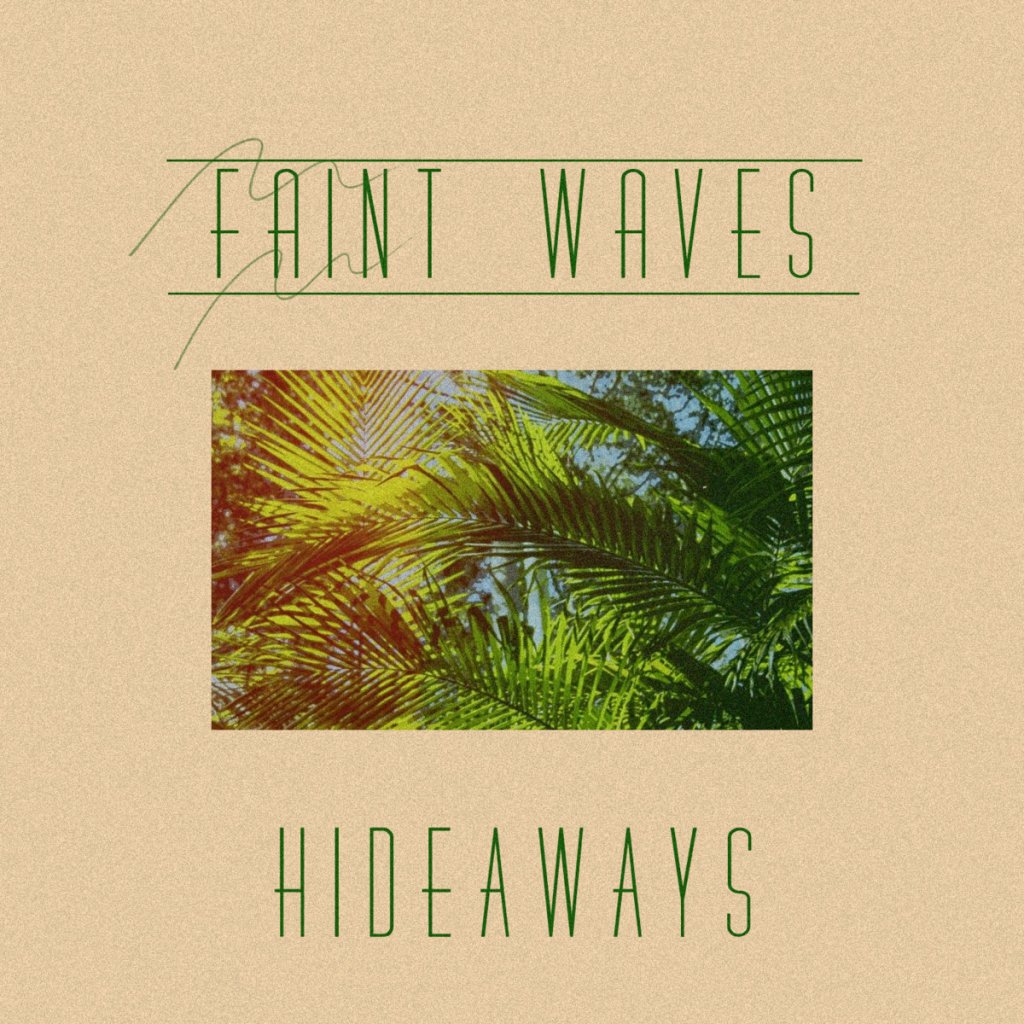
Hideaways came out July 8th, 2017. Why celebrate this specific release, you might ask? Hideaways proved a pivotal release in the Faint Waves canon. It marked my greatest “success” up to that point in my musical tenure, and it arguably led me down a musical road that I’m still sort of going down almost 10 years later. It had a lasting impact and, for many people, was an introduction to me and my work. It’s the sort of release where, if I hadn’t made it, the sheer butterfly effect of that could’ve altered my musical path immensely; I may have never worked with certain labels. In fact, I can say for certain that I never would’ve licensed a track to the legendary Café del Mar. I know that because the first incarnation of “Bonita” (a song that would be remixed and later licensed for Café del Mar Dreams XI), was included on the sequel to Hideaways (the aptly named Hideaways II).
Listening back to it now, it’s not a musically deep or complex release, but it’s really trying to be. It’s an amalgam of the simple sounds and tools I had available to me at the time, as well as my limited musical ability, being used to craft something that resonated with me and was deeply informed by my many inspirations. The EP opener, “Congo”, was inspired by Fleetwood Mac, more specifically Tango In The Night. Tango In The Night has long been a favorite Fleetwood Mac record of mine, a favorite record from what is (to date) my favorite band of all-time. It’s in small ways that you can hear it maybe; the breathy pads in place of the breathy band harmonies, the pitch-bent synth brass, the thick snare. Track 2, “Borrasca”, I couldn’t say what inspired it but it feels reminiscent of Robert Plant’s “Ship Of Fools” (that theory probably has legs given the use of that song in Miami Vice and the title I chose also being a reference to the series), with a touch of Lindsey Buckingham or Al Di Meola influence as well.
As the EP goes on, the sound expands, and you start to get a sense of my Exotica and New Age influences. The third song on the extended play is “Hideaway”, a soulful downtempo joint featuring marimba, steel drums, and a shakuhachi. The string pads are evocative and serve as a precursor to the more chord and pad-driven works to come. You can hear a lot of Arthur Lyman and Enigma in what I was attempting, just not remotely as musical or complex. Track 4, “Quiet Storm”, melds a lot of the aforementioned sounds and influences into a singular cohesive piece. At the time, I was a part of many Synthpop and Synthwave-related communities, and while I never really made that music—I was regularly adjacent to it. While more Chillwave in its approach, this song is probably the most influenced by the sounds that were coming out at that time in those communities; the punchy snare, the CR-78 hat, the synthetic saxophone. People seemed to respond well to that tune and I think it’s because it had atmosphere and was doing so many things, while still being a functional (if monotonous) piece of music.
While that’s where the EP ended, the story continued, and Hideaways became a trilogy of EPs that I released from 2017 to 2020. I have no plans to return to the Hideaways series. I feel it served its purpose, and I’ve moved on to different sonic pastures, but there’s no denying the impact it had and how it informed my musical journey. Not everything, but much of what has come since, it’s an extension and evolution of what I was doing on Hideaways. Now, of course, I have more focus and a better grasp on sound and music in general, but then? I was trying to bring something to life that I believed in, and it’s hard to be critical of that pure of an intention. No matter how it quite turned out on a technical level, I feel the vision was and still is there. There’s a reason why Hideaways was the most simple and mellow release I had done up to that point: the rest of my existence was unnerving chaos, and it was a reaction in opposition to that. At that time, I was giving sobriety a shot (I had three months at the time of Hideaways’ release), attempting to navigate life as a young adult. It was a strange and frankly scary time. It turned out okay, obviously, because I’m here now to talk about it. Then though? I wasn’t doing well, I felt increasingly isolated from my friends and what people my age were doing, it felt like I couldn’t talk to anyone. All I did was go to work, make music, and drive. I did a lot of driving. Twin Peaks: The Return was on TV at the time too and I remember feeling a sort of kinship with the artistic madness of the show, like it somehow articulated the chaotic abstraction of my mental and physical health at the time. That sort of sums it up. All there was, was me, an indefinite road I was going down, art, and music.
That’s Hideaways.
Thank you for reading.
~ FW.
 FAINT WAVES
Leave a comment