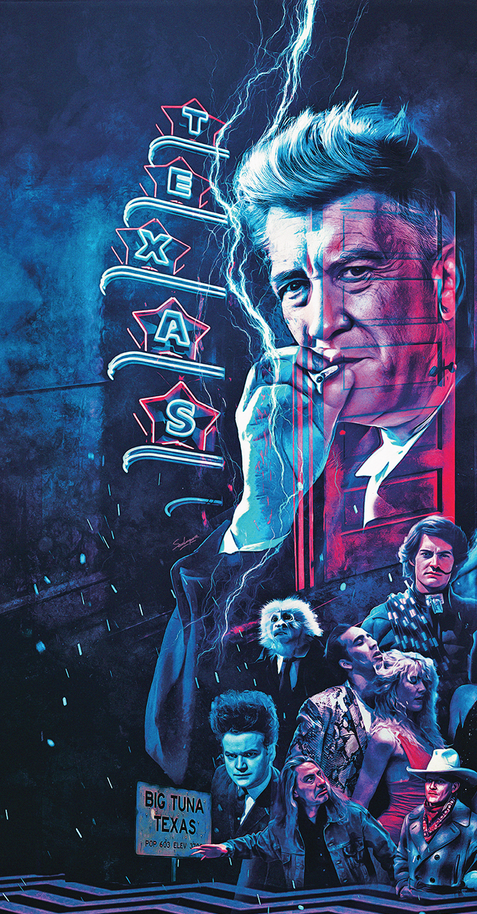
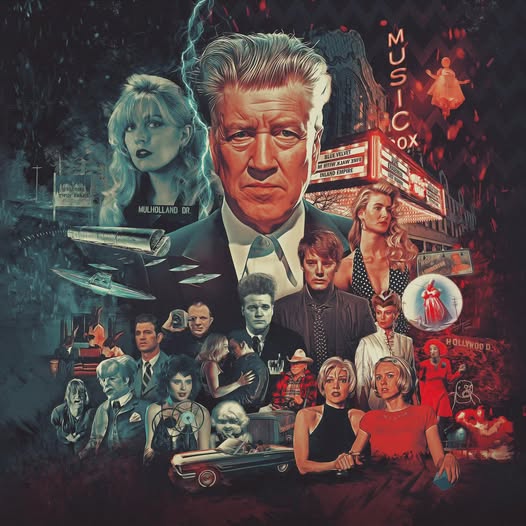
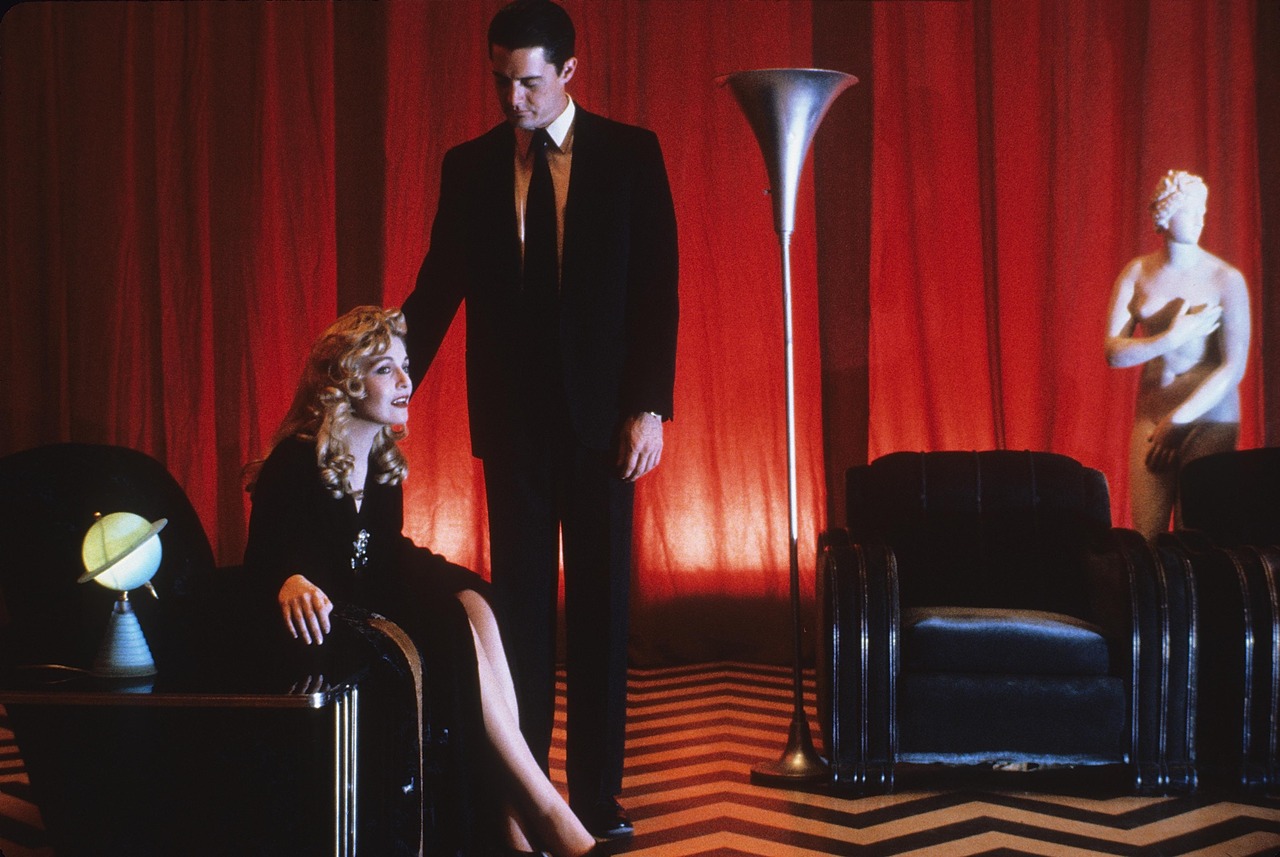
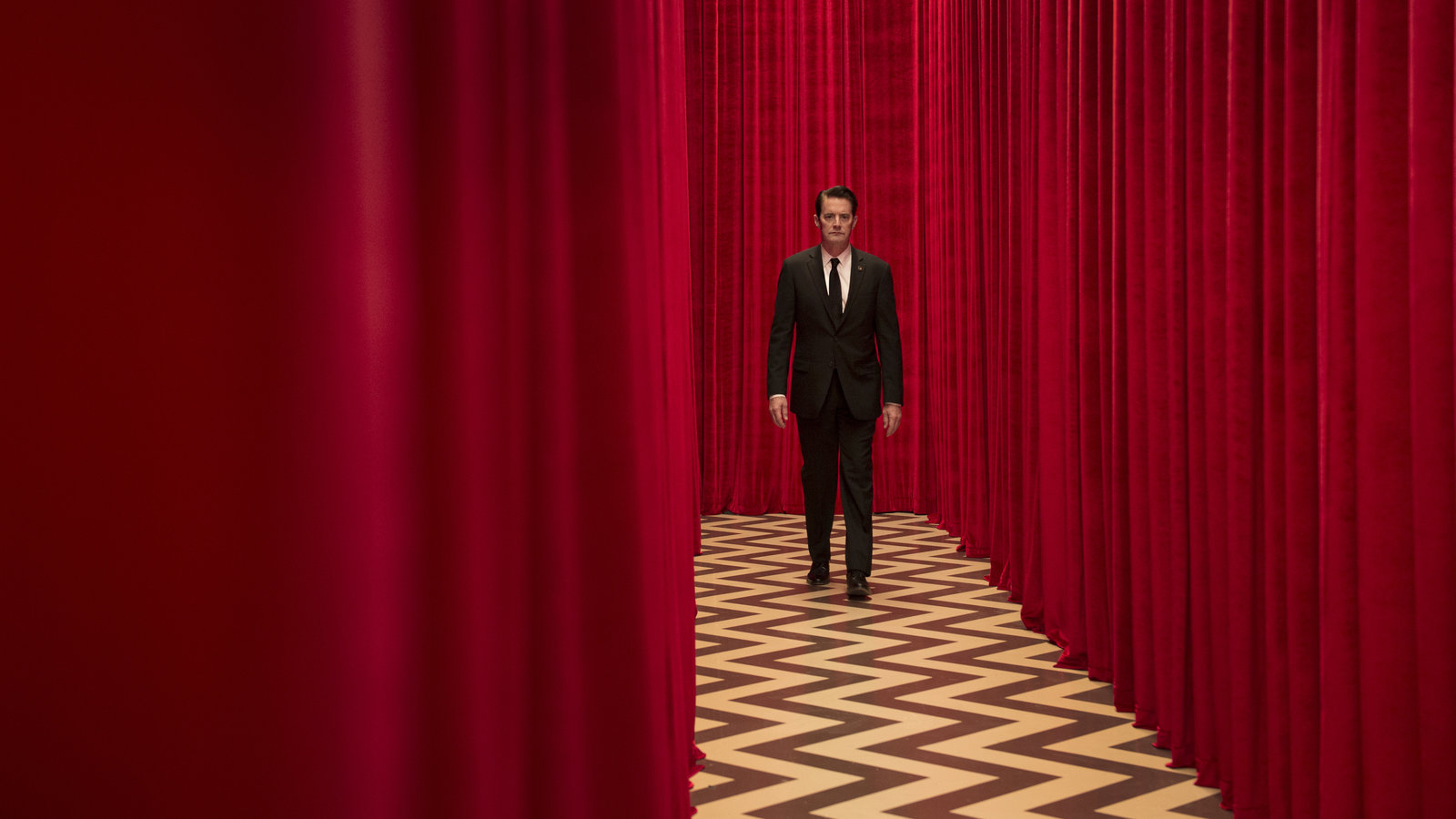

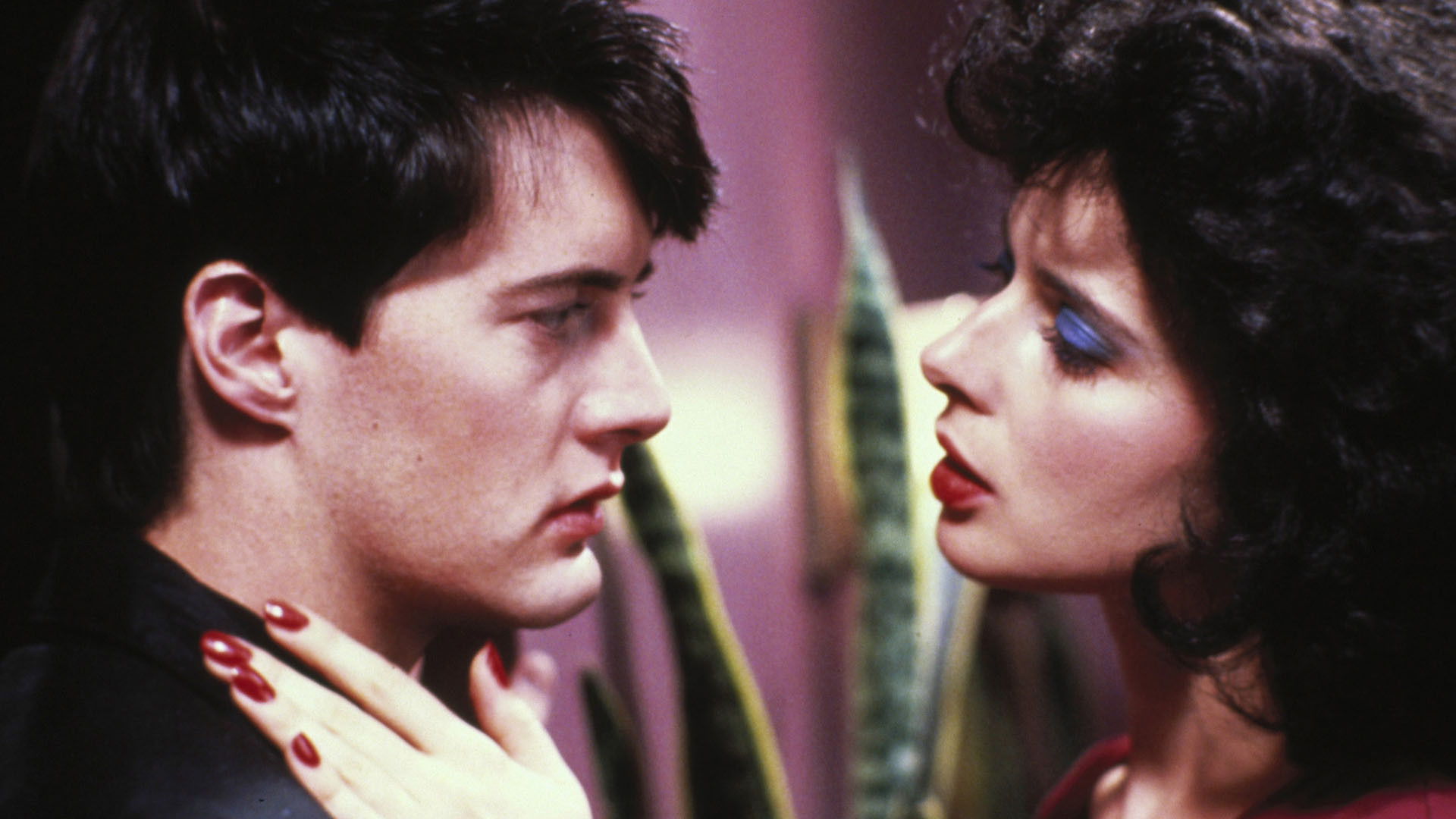

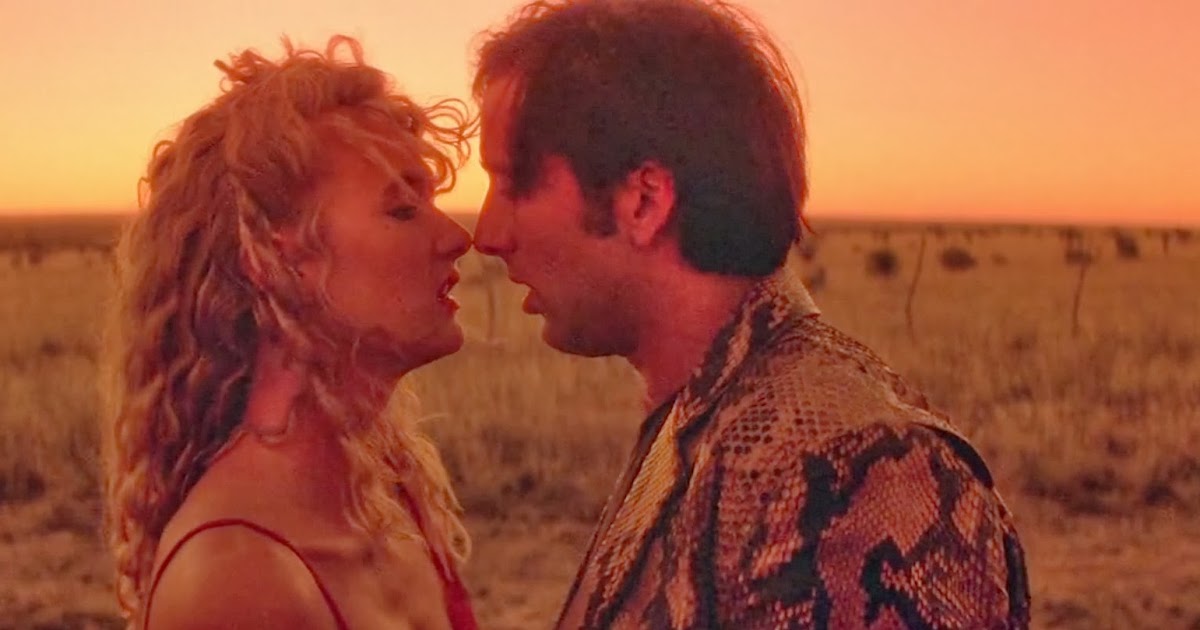
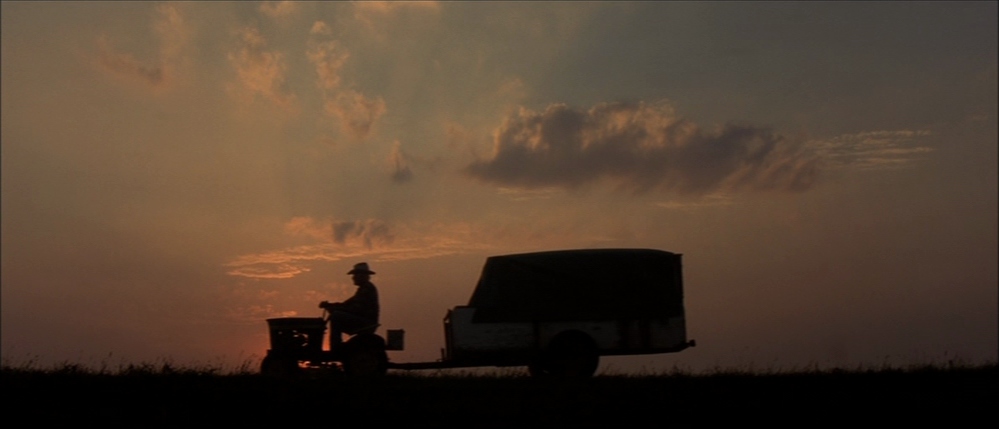
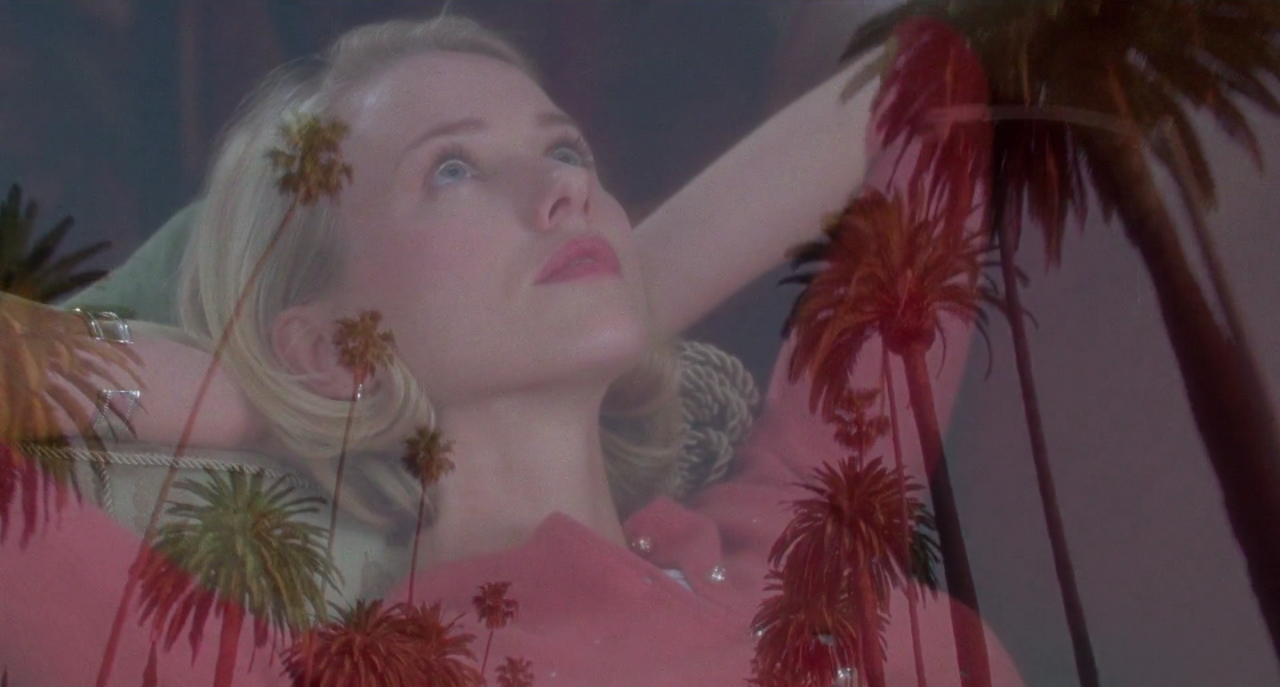
Art by Sean Longmore, accompanied by various stills from Twin Peaks, Twin Peaks: The Return, Lost Highway, Blue Velvet, Wild At Heart, The Straight Story, and Mulholland Drive, respectively.
Last week, we lost a titan of art, pop culture, and film. David Lynch sadly passed away. As evidenced by the outpouring of tributes and condolences in the time since, he and his work were beloved by countless people, and there is undoubtedly a hole in the creative world with him gone. That’s why I’m writing this piece, just an attempt to reconcile and recognize the loss of an enormous talent, a true one of one.
I’ll admit, I have a bad habit of eulogizing when someone I appreciate passes away. I think that largely stems from a desire to not only show my respects but also say, “It’s important that you were here, and it’s important that you’re gone”. That’s the very least I could say when it comes to David Lynch. A true purveyor of the strange and surreal, yet equally adept at portraying the mundane and trivial; that very contrast is how much of his work can be summed up. The droll, workaday, terrestrial elements of a Lynch work were often the anchor for an otherwise abstract, dream-like, or outright unusual narrative. Lynch was a master of the bizarre, and a lot of that is down to his explicit artistic vision, his desire to let you (the viewer) interpret the madness, and the atmosphere conjured by those he often collaborated with. It’s impossible to write something that wholly encapsulates an artist like David Lynch, but I’m going to do my best to honor him and his work while focusing on some of my favorites in the Lynch canon and how he has inspired me. I attempted to come up with an outline for this, but I’ve ultimately decided to just have it be a stream of consciousness; maybe he would’ve preferred it that way.
David Lynch, as an artist, is not for everyone. His vision was singular and, frankly, not always fit for easy public consumption. That is what makes his success and impact all the more impressive; it takes a true visionary to reach people with the bizarre and otherworldly, to make uncomfortable or unnerving madness both compelling and somehow palatable. Sure, we’ve become more accepting of things once deemed strange or merely different, but even by today’s standards, Lynch was operating on a level that no one else was or has since. As recently as 2017, Lynch delivered one of the strangest pieces of modern television with Twin Peaks: The Return. It is a small miracle that a third season of Twin Peaks was allowed to happen at all, even more so that it aired in the shape that it did. It is Lynchian, almost to a fault, and it’s all the better for it. In a world of sequels, revivals, remakes, and reboots with questionable merit, Lynch returned to one of his biggest outings in spectacularly bewildering fashion, as only he could. It was confounding, messy, avant-garde, yet poignant, striking, and beautiful. In many ways, it makes sense that it was (unfortunately) his last major creative outing; it’s both a full-circle moment and a distillation of all that Lynch was. Fittingly too, it utilizes many prior Lynch collaborators: Kyle MacLachlan (star of the original Twin Peaks, of course, but also other Lynch works such as Dune and Blue Velvet), Laura Dern, Harry Dean Stanton, Naomi Watts, Angelo Badalamenti, and Julee Cruise, among others. A true victory lap, whether he intended it to be or not.
You might notice a couple of those names I mentioned aren’t actors at all, but musicians instead, which brings me to the role that music and sound have played in Lynch’s vision. This is also sort of where I factor in as a David Lynch fan, as I’m not only drawn in by the surreal writing and visuals he often employs but the ambiance and music as well. Whether it’s David Bowie, Moby, Nine Inch Nails, or Lana Del Rey, you can connect Lynch to a myriad of music acts, and for good reason. On top of being a musician himself, David Lynch excelled at creating an aural space to accompany the writing and visuals of his work. Whether it was utilizing instrumental pieces by Chris Isaak for Wild At Heart or using Julee Cruise to truly ethereal effect in both Blue Velvet and Twin Peaks, Lynch knew how to construct an evocative audio backdrop for the goings-on of his work. Some of my favorite moments in the aforementioned works are punctuated beautifully by the musical decision making. Wild At Heart, my personal favorite in the Lynch filmography, heavily features one of my favorite artists: Chris Isaak (whom I was lucky enough to see live in 2022; terrific show, highly recommended). The aforementioned film is partially responsible for bringing Chris Isaak to the mainstream (he was featured in Blue Velvet too but the song didn’t hit big like Wicked Game would), creating a sleeper hit out of “Wicked Game” (which would go on to feature a Lynch-directed music video, comprised of footage from Wild At Heart interspersed with newly filmed black and white shots of Chris and his backing band) and bringing focus to his album, Heart Shaped World. Heart Shaped World featured “Wicked Game” and “Blue Spanish Sky”, both of which are used to terrific instrumental effect in Wild At Heart.
To bring myself and my own music into focus, I’ve always worn my inspirations on my sleeve; they thankfully tend to get at least a little bit obscured when I do my thing. I mentioned Chris Isaak, though, and one of my favorite songs I’ve ever produced, “Mirage”, it’s very obviously my riff on “Wicked Game” and another Isaak hit, “Can’t Do A Thing To Stop Me”. Simultaneously, it too features a filmic quality that might evoke Lynch for some people; the bucolic guitar tones and sleazy vibraphone are very much in tune with the Psychedelic-Americana-Noir that David Lynch specialized in. To expand on that point, Lynch and specifically his long-term collaboration with Angelo Badalamenti have certainly had a profound impact on me as a musician. I am not the composer that Badalamenti was, but he is certainly among the names of individuals who have influenced my way of writing and producing music. I’ve often cited Anne Dudley (ABC, Art Of Noise, Electronic, etc.) and Angelo Badalamenti as having a significant influence on me, particularly in how I build songs around synth chords, I’d very much liken it to orchestral strings. One of my favorite compliments I ever received was as follows, verbatim: “So calming, beautiful atmospheres and guitar melodies. Reminds me of Angelo Badalamenti at times, as if The Straight Story was based on an island in the Mediterranean”. That comment is taken from my Bandcamp page; it’s made in regards to my 2024 single, “The Sunset Fades”. While I cannot say it was my intent, I do hear the similarity and am flattered that someone else made such a connection. It just goes to show that great art, it sticks with you, and you wind up drawing on it (whether you realize it or not in the moment).
That’s what Lynch was, by the way, great art. He’s an unlikely but well-deserved icon of cinema. His work, magnificently odd as it may be at times, managed to find its way into the zeitgeist. It’s in small ways, too, that it has woven itself into the fabric of popular culture, whether it’s visual cues, music, or quotes. Something I’ve been saying my entire life, “people are frightened by what they don’t understand”, is a direct quote from Lynch’s The Elephant Man (popularized there at least; the film’s subject, Joseph Merrick, actually said it back in the 1800’s), and a quote that rings as true today as it did then. Granted, I had never seen The Elephant Man, and versions of the quote have existed elsewhere, but that exact phrasing was simply something that existed in the ether. Someone else said it, or it was recycled in another piece of media, and it stuck with me. That’s a good metaphor for a lot of David Lynch’s work, it gets under your skin, and it sticks around; it seeps into the art and media of others in ways big and small. The impact, the ripple effect, that is perhaps the best indicator of Lynch’s success in film; do not look at accolades, numbers, reviews, or anything of that nature. Rather, look at who it reached; look at who it affected. If his passing has illustrated anything, it is the profound and nearly immeasurable influence that he and his body of work have had. David Lynch was, arguably, an artistic vessel explicitly for the absurd, the obscene, and the peculiar. He presented it to us, and most of us, we didn’t shriek or cringe or bemoan; we instead saw art, or we saw ourselves, or we saw something we didn’t understand (but wanted to). We connected with it. Lynch himself had a thought on that, a connection, some invisible tether made through art and ideas.
“I think that ideas exist outside of ourselves. I think somewhere, we’re all connected off in some very abstract land. But somewhere between there and here ideas exist.” – David Lynch.
I think he’s right, and if I’ve been shown anything in the last few days, we are all connected in that abstract land. To paraphrase what I said on Instagram when I first heard of his passing: very few people out there get to be as successful as they are strange, David Lynch was both, in spades.
Rest in peace.
 FAINT WAVES
Leave a comment